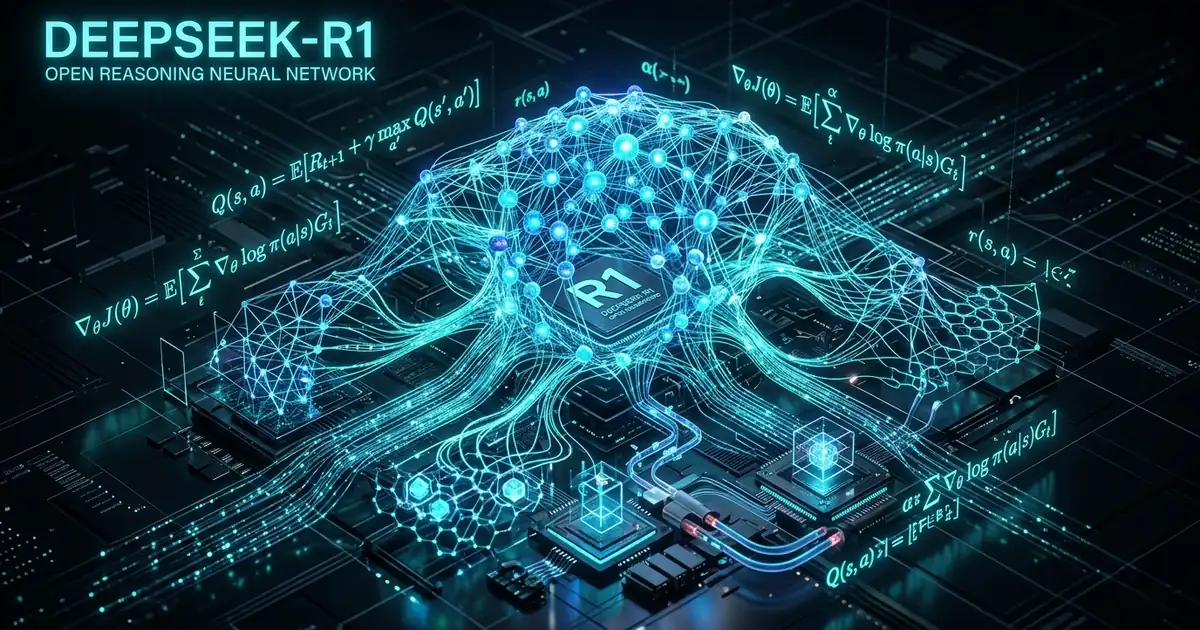
The release of DeepSeek-R1 represents a watershed moment in artificial intelligence. For the first time, an open-weights frontier model has matched proprietary reasoning engines like OpenAI o1 while publishing its complete architectural recipes, training paradigms, and distilled artifacts.
What makes DeepSeek-R1 revolutionary is not merely its performance on American Invitational Mathematics Examination (AIME) or Codeforces benchmarks; it is the revelation that complex multi-step reasoning can emerge spontaneously through pure reinforcement learning (RL) without human-labeled cold-start chains of thought.
In this deep dive, we deconstruct the mathematics of Group Relative Policy Optimization (GRPO), explore the transition from R1-Zero to R1, analyze its multi-stage pipeline, and assess what this means for enterprise AI engineering in 2026.
The Flaw of Traditional PPO: Why RLHF Hit a Wall
In traditional Reinforcement Learning from Human Feedback (RLHF), Proximal Policy Optimization (PPO) requires maintaining two separate models during training:
- An Actor model (the policy $\pi_\theta$ being trained).
- A Critic model (a value network $V_\phi$ estimating the expected future reward for a given state).
For a 671-billion parameter Mixture-of-Experts (MoE) model like DeepSeek-V3, hosting both the actor and a similarly sized critic in GPU memory requires massive tensor and pipeline parallelism overhead. Critic models often consume 30% to 50% of the entire training cluster VRAM, creating a severe bottleneck.
Traditional PPO Pipeline:
[Prompt] ───> [Actor Policy π_θ] ───> [Generated Response]
     │                                        │
     └────────> [Critic Network V_φ] ─────────┴───> [Generalized Advantage Estimation (GAE)]
Group Relative Policy Optimization (GRPO)
DeepSeek solved this dilemma by discarding the Critic network entirely. Instead of estimating absolute state values, GRPO evaluates policy updates by sampling a group of outputs for each prompt and computing the relative advantage of each sample compared to the group mean.
Given a prompt $q$, the policy generates a group of $G$ candidate outputs ${o_1, o_2, \dots, o_G}$. Each candidate receives a scalar reward $r_i$ based on rule-based verifiers (e.g., test case execution for code, final numerical equality for mathematics).
The normalized advantage $A_i$ for output $o_i$ is computed as:
$$A_i = \frac{r_i - \text{mean}({r_1, \dots, r_G})}{\text{std}({r_1, \dots, r_G}) + \epsilon}$$
By normalizing over the group, the model determines which response succeeded relative to peer attempts, optimizing the surrogate objective:
$$\mathcal{J}{\text{GRPO}}(\theta) = \mathbb{E} \left[ \frac{1}{G} \sum{i=1}^G \min \left( \frac{\pi_\theta(o_i|q)}{\pi_{\text{old}}(o_i|q)} A_i, \text{clip}\left(\frac{\pi_\theta(o_i|q)}{\pi_{\text{old}}(o_i|q)}, 1-\varepsilon, 1+\varepsilon\right) A_i \right) - \beta D_{\text{KL}}(\pi_\theta \parallel \pi_{\text{ref}}) \right]$$
# Minimal PyTorch Implementation of GRPO Advantage Computation
import torch

def compute_grpo_advantages(rewards: torch.Tensor, eps: float = 1e-8) -> torch.Tensor:
    """
    Computes group relative advantages across candidate responses.
    rewards shape: (batch_size, group_size)
    """
    mean = rewards.mean(dim=-1, keepdim=True)
    std = rewards.std(dim=-1, keepdim=True)
    advantages = (rewards - mean) / (std + eps)
    return advantages

# Example: 4 prompts, 8 samples each
rewards = torch.tensor([
    [1.0, 0.0, 1.0, 0.0, 1.0, 1.0, 0.0, 1.0],  # Math problem A
    [0.0, 0.0, 0.0, 0.0, 1.0, 0.0, 0.0, 0.0],  # Difficult problem B
])
adv = compute_grpo_advantages(rewards)
print("Computed GRPO Advantages:\n", adv)
The "Aha Moment" and Natural Emergence of Reasoning
In DeepSeek-R1-Zero (the pure RL experiment without initial supervised fine-tuning), the authors observed an emergent behavior nicknamed the "Aha Moment".
As training progressed:
- Self-Correction: When faced with a complex geometry or algebra question, the model began spontaneously writing tokens like "Wait, let me double-check my previous assumption" or "Actually, if x is negative, the boundary condition fails..."
- Exploratory Backtracking: The token length expanded autonomously from 800 tokens to over 4,500 tokens as the policy learned that spending compute during inference ("thinking") dramatically boosted reward probability.
- Language Mixing: Without warm-up data, R1-Zero mixed languages mid-thought (switching between Chinese and English). To resolve this, DeepSeek introduced a small, curated Cold-Start SFT dataset (several thousand examples) before RL, producing the production-grade DeepSeek-R1.
Benchmark Comparison: DeepSeek-R1 vs Proprietary Giants
| Benchmark | DeepSeek-R1 (671B MoE) | OpenAI o1-preview | OpenAI o1 (full) | Claude 3.5 Sonnet |
|---|---|---|---|---|
| AIME 2024 (Pass@1) | 79.8% | 44.6% | 79.2% | 16.0% |
| MATH-500 | 97.3% | 74.6% | 96.4% | 78.3% |
| Codeforces Percentile | 96.3% | 62.0% | 96.6% | 77.0% |
| MMLU | 90.8% | 90.8% | 91.8% | 88.7% |
| SWE-bench Verified | 49.2% | 41.6% | 48.9% | 49.0% |
Distillation: The 1.5B to 70B Revolution
Perhaps the most impactful takeaway for production engineering is DeepSeek's distillation strategy. Rather than running RL directly on smaller architectures (which struggle with sparse rewards), DeepSeek distilled 800,000 reasoning trajectories generated by R1 into standard Qwen and Llama architectures.
The results are staggering:
- DeepSeek-R1-Distill-Qwen-14B outperforms Qwen-2.5-32B and rivals GPT-4o on mathematical reasoning.
- DeepSeek-R1-Distill-Llama-70B scores 70.0% on AIME 2024, running on a single 8x A100/H100 node or dual Mac Studio machines via llama.cpp.
Production Architectural Takeaways
- Rule-Based Verifiers Over Reward Models: Reward models suffer from reward hacking. For code, math, and structured schemas, deterministic compilers and test runners provide unhackable training signals.
- Inference-Time Compute is the New Frontier: Scaling pre-training compute faces diminishing returns and data walls. Test-time compute (extended thinking) unlocks qualitative reasoning leaps at a fraction of pre-training cost.
- Open Weights Have Caught Up: Enterprise RAG, agentic coding, and financial compliance pipelines no longer require closed API lock-in.