The paradigm of AI interaction has fundamentally shifted. For two years, Large Language Models operated primarily as advisory conversationalists: users asked questions, and the model returned text.
With the unveiling of OpenAI Operator and the emergence of Computer-Using Agents (CUA), models have ceased to be passive advisors. They have become active operators capable of driving standard web browsers, navigating multi-factor authentication, parsing complex single-page apps (SPAs), and completing end-to-end multi-step tasks.
How Web Agents Work: Dual-Mode Perception
Autonomous web navigation requires solving two deeply interconnected challenges:
- Semantic Grounding: What elements exist on the screen and what are their semantic functions?
- Action Execution: What precise OS or browser primitives (click, type, scroll, drag) must be dispatched to trigger the intended state transition?
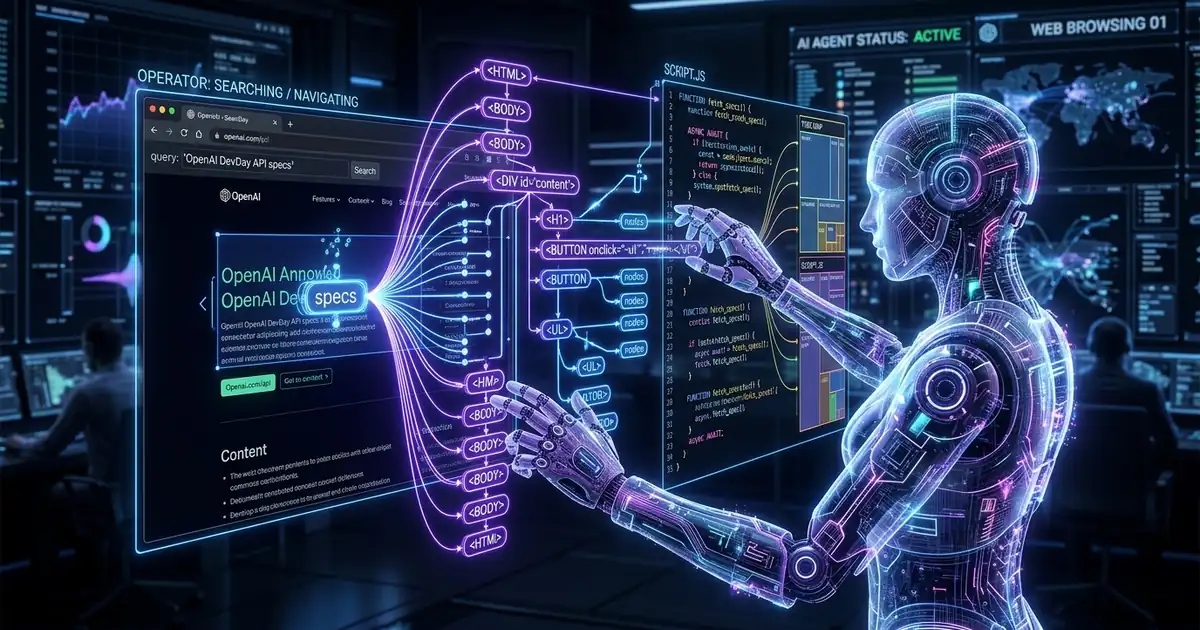
Leading agents combine DOM-Tree Serialization with Vision-Coordinate Grounding:
Perception Pipeline:
                    ┌─────────────────────────┐
                    │  Live Browser Session   │
                    └────────────┬────────────┘
                                 │
           ┌─────────────────────┴─────────────────────┐
           ▼                                           ▼
┌──────────────────────┐                   ┌──────────────────────┐
│  Accessibility Tree  │                   │  Viewport Screenshot │
│  (Filtered DOM JSON) │                   │  (With Set-of-Marks) │
└──────────┬───────────┘                   └──────────┬───────────┘
           │                                           │
           └─────────────────────┬─────────────────────┘
                                 ▼
                    ┌─────────────────────────┐
                    │ Multi-Modal Vision LLM  │
                    │   (OpenAI Operator /    │
                    │    Claude 3.7 Vision)   │
                    └────────────┬────────────┘
                                 ▼
                     Action Dispatch: {
                       action: "click",
                       coordinate: [640, 420],
                       expectedOutcome: "Navigates to Checkout"
                     }
Resilience Engineering: Handling Captchas, Modals, and Hydration Delays
Building web agents in controlled demos is easy; running them across real-world web environments is notoriously fragile. Production implementations require:
- State Verification Loops: After issuing a
clickevent, the agent takes another screenshot to verify that the URL changed or a modal opened. If the DOM remains unchanged after 3 seconds, it switches from coordinate click to DOM element injection. - Context Window Compression: Passing full HTML dumps blows past token limits and introduces noise. Agents prune the accessibility tree, retaining only interactive elements (
a,button,input,select) with computed bounding boxes. - Session Cookies and Sandboxed Profiles: Enterprise agents operate inside ephemeral Dockerized Chromium containers, injecting pre-authenticated session tokens to bypass repetitive OAuth logins.
The Economic Impact: From SaaS APIs to Universal Automation
Historically, automating workflows between two SaaS platforms required both vendors to offer robust REST APIs. If Vendor A had no API, automation was dead on arrival.
Web agents obliterate this constraint. Any software that can be used by a human through a browser can now be operated autonomously by software agents. From automated procurement in legacy ERPs to competitor price intelligence, the browser has become the universal API.