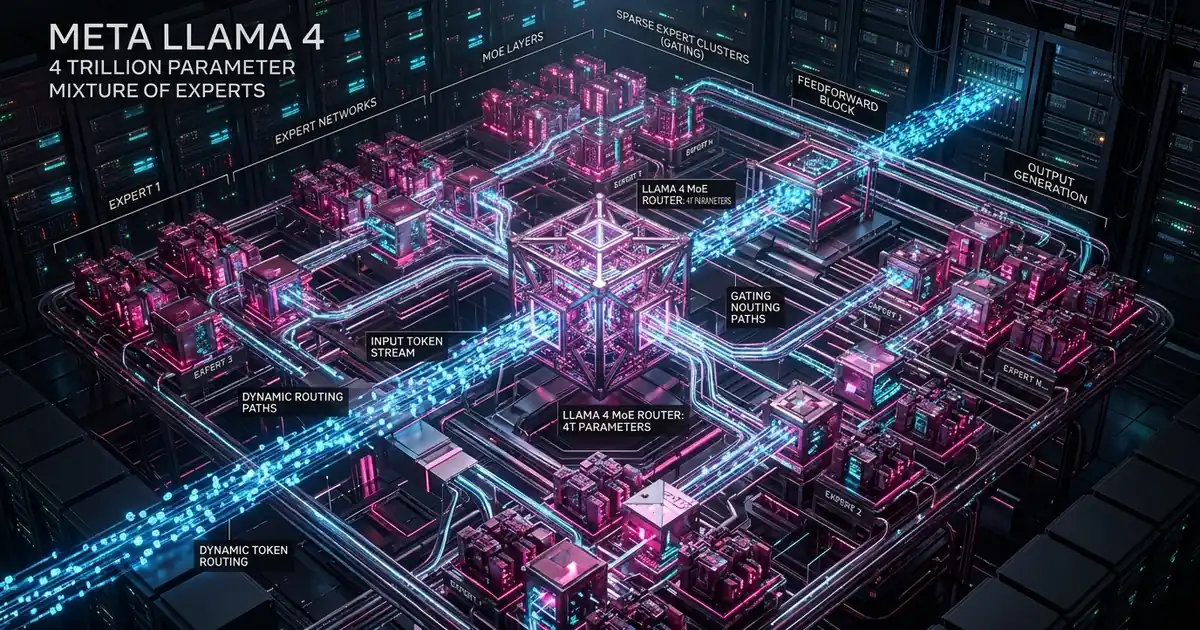
Meta AI's Llama series has been the bedrock of open-source artificial intelligence. With the development and release of Llama 4, Meta has fundamentally transitioned from dense transformer architectures to massive Sparse Mixture-of-Experts (MoE) models spanning over a trillion total parameters while activating only a lean fraction per forward pass.
This architectural shift mirrors the techniques used in frontier models like DeepSeek-V3 and GPT-4, bringing unconstrained frontier reasoning into private enterprise data centers.
Architecture Comparison: Llama 3 vs Llama 4
| Architectural Dimension | Llama 3 (405B) | Llama 4 (MoE Architecture) |
|---|---|---|
| Parameter Topology | Dense 405 Billion | Sparse 1.2 Trillion (Total) |
| Active Parameters / Token | 405 Billion | ~48 Billion (Top-4 Routing) |
| Context Window | 128,000 tokens | 1,000,000 tokens (Native) |
| Attention Mechanism | Grouped Query Attention (GQA) | Multi-Head Latent Attention (MLA) |
| Native Precision | FP8 / BF16 | Native FP4 / NVFP4 Support |
| Inference Latency | High (~25 tok/s on 8x H100) | Ultra-High (~95 tok/s on 8x H200) |
Multi-Head Latent Attention (MLA) and KV Cache Compression
A critical limitation of Llama 3 405B was the astronomical memory required to store the Key-Value (KV) cache during long-context inference. At 128k context, the KV cache alone consumed tens of gigabytes per concurrent user.
Llama 4 integrates Multi-Head Latent Attention (MLA):
- Instead of caching full Key and Value projections, the model compresses Key and Value matrices into low-dimensional latent vectors during generation.
- The KV cache footprint drops by 85%, enabling servers to sustain 6x more concurrent requests without memory thrashing.
Deploying Llama 4 on Private Infrastructure
For enterprises operating under strict data sovereignty requirements (GDPR, HIPAA, financial compliance), Llama 4 delivers sovereign frontier capabilities.
With FP4 quantization running on NVIDIA Blackwell (B200) or H200 clusters:
- A single 8-GPU node can serve the full model with high throughput.
- Latency drops below 15ms per token, making real-time voice and agentic loops economically viable.
The democratization of trillion-parameter intelligence ensures that no single proprietary vendor holds a monopoly on frontier reasoning.