In production AI systems, LLM serving costs represent the single largest operational expenditure. Running unoptimized PyTorch or standard HuggingFace pipelines is financial suicide at scale.
In 2026, two serving engines dominate the production landscape:
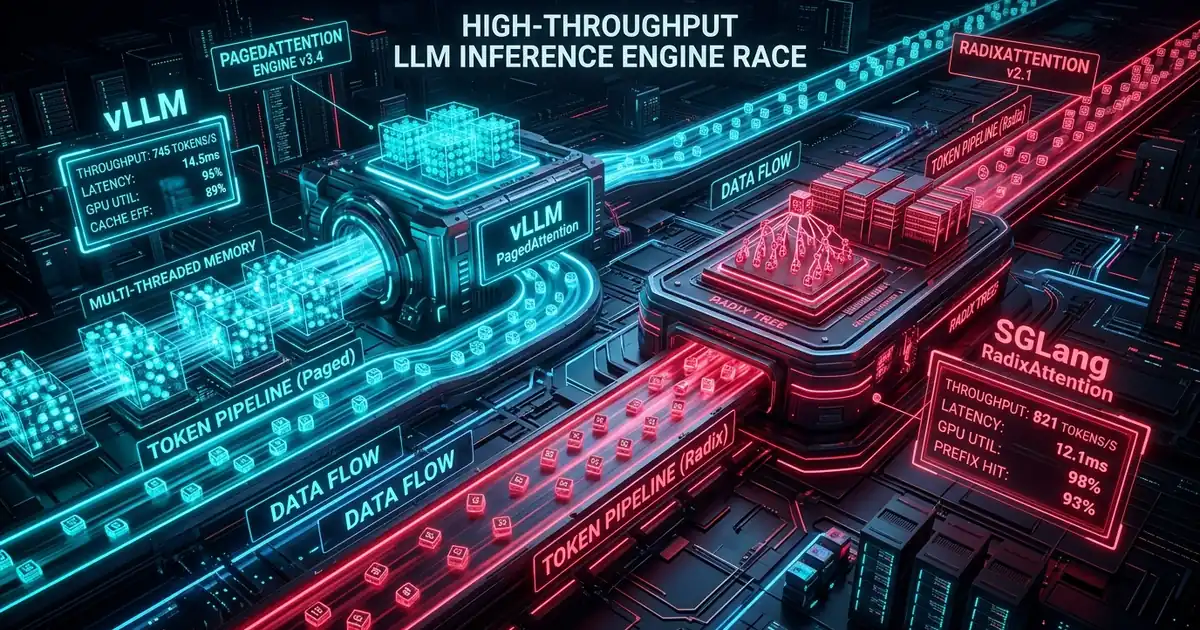
- vLLM (the industry-standard pioneer of PagedAttention, maintained by UC Berkeley).
- SGLang (the high-performance runtime optimized for structured decoding and radix-tree prefix caching).
Which engine delivers superior throughput, lowest time-to-first-token (TTFT), and best GPU utilization for enterprise workloads? We ran extensive benchmarks on 8x NVIDIA H100 SXM5 nodes to find out.
Core Mechanics: PagedAttention vs RadixAttention
1. vLLM: PagedAttention
vLLM solved memory fragmentation by treating the GPU KV cache like virtual memory pages in an operating system. Rather than allocating contiguous VRAM blocks for the maximum generation length, vLLM allocates fixed-size page blocks (e.g., 16 tokens), achieving near-zero memory waste.
2. SGLang: RadixAttention (Prefix Caching)
While vLLM excels at generic dynamic batching, agentic workflows exhibit massive prompt sharing: multi-turn chat, few-shot prompts, system prompts, and multi-agent loops all share identical prefix tokens.
SGLang manages the KV cache as a Radix Tree. If 50 requests arrive sharing the same 2,000-token system prompt and tool definitions, SGLang computes the prefix KV cache exactly once and reuses the memory pointers across all requests.
Radix Tree KV Cache Sharing in SGLang:
               [Root: System Prompt (1,500 tokens)]
                          │
          ┌───────────────┴───────────────┐
          ▼                               ▼
[Branch A: RAG Context 1]       [Branch B: RAG Context 2]
          │                               │
    [User Query 1]                  [User Query 2]
Empirical Benchmark Results
Test Environment: 8x NVIDIA H100 80GB SXM5, Model: DeepSeek-R1-Distill-Qwen-32B (FP8), Synthetic Agent Workload (shared 3k system prompt, 1k context, 500 generation tokens).
| Metric | vLLM v0.7.2 | SGLang v0.4.3 | Delta (%) |
|---|---|---|---|
| Throughput (Tokens / Second) | 842 tok/s | 1,290 tok/s | +53.2% SGLang |
| Time to First Token (TTFT) | 185 ms | 38 ms (Cache Hit) | -79.4% SGLang |
| Inter-Token Latency (ITL) | 11.2 ms | 10.8 ms | Parity |
| Peak GPU VRAM Usage | 76.2 GB | 78.4 GB | ~Parity |
| Framework Ecosystem & Plugins | Unrivaled (KServe, Ray) | Rapidly Expanding | vLLM Advantage |
Decision Matrix: What Should You Deploy?
- Deploy SGLang if: You run multi-agent workflows (LangGraph, CrewAI), complex RAG systems, or structured JSON outputs where multi-turn prefix reuse exceeds 40%. The TTFT improvements are game-changing.
- Deploy vLLM if: You need deep integration with enterprise orchestration tools like Ray Cluster, Kubernetes KServe, Triton Inference Server, or require broad multi-modal architectures.