AI Orchestration Patterns: Choreography vs. Conductor Models for Multi-LLM Enterprise Pipelines
Modern AI applications rarely use a single model. A typical enterprise pipeline might route simple queries to a 7B SLM, complex reasoning to Claude Opus, and code generation to a specialized fine-tuned model. AI Orchestration is the discipline of managing these multi-model workflows.
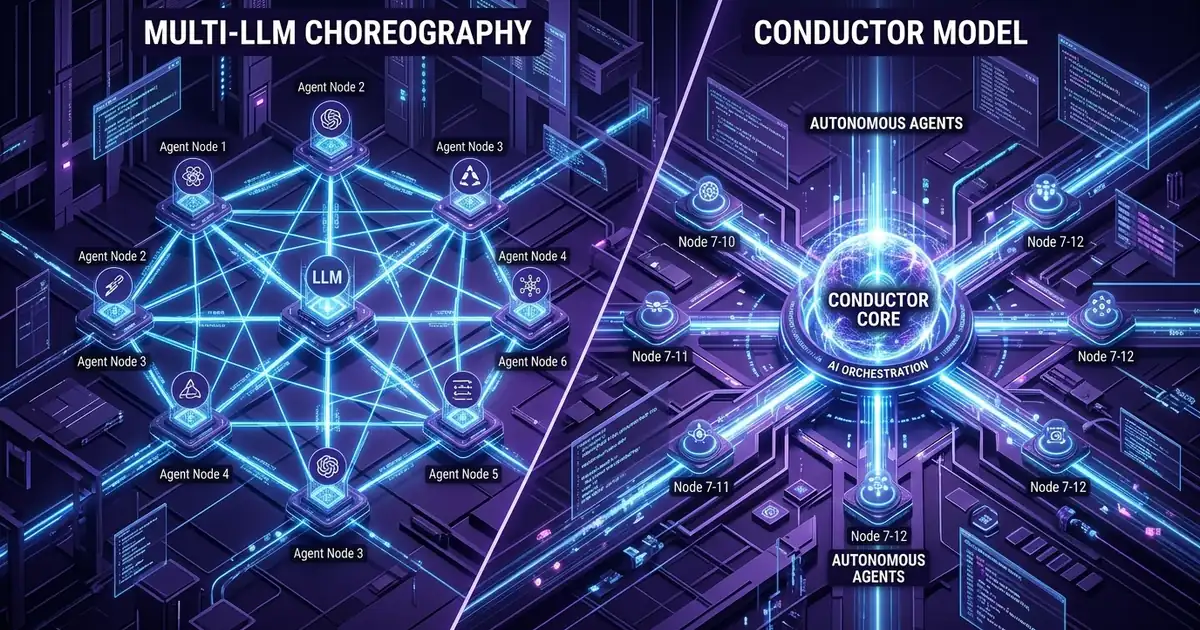
1. Choreography vs. Conductor
| Pattern | How It Works | Best For |
|---|---|---|
| Choreography | Each service knows what to do next and triggers the next step independently | Loosely coupled microservices |
| Conductor | A central orchestrator directs all steps and manages state | Complex multi-step workflows |
2. Conductor Pattern Implementation
class AIConductor {
  private steps: PipelineStep[] = [];

  addStep(name: string, model: string, transform: Function) {
    this.steps.push({ name, model, transform });
  }

  async execute(input: any): Promise<any> {
    let state = input;
    for (const step of this.steps) {
      console.log(`Executing: ${step.name} with ${step.model}`);
      const llmResponse = await callModel(step.model, state);
      state = step.transform(llmResponse);
    }
    return state;
  }
}

// Usage
const pipeline = new AIConductor();
pipeline.addStep("classify", "gemma-4-12b", extractIntent);
pipeline.addStep("reason", "claude-opus", generateAnalysis);
pipeline.addStep("format", "gemma-4-12b", formatMarkdown);
await pipeline.execute(userQuery);
Choosing the right orchestration pattern determines whether your multi-LLM system scales gracefully or collapses under coordination overhead.